Almost every conversation about buying property in Cyprus starts the same way. The buyer says they want something finished, ideally with a title deed, ready to move into or to rent out so the investment earns from day one. The instinct makes sense. Buying abroad already asks for a degree of trust, and a building that does not yet exist adds an expectation that nothing can fill except your own imagination.
What follows is usually the same sequence. The buyer studies the market, sees that there is very little completed stock left in Limassol, Paphos and Larnaca, and that what remains tends to be the last units, the ones nobody chose earlier. Demand for Cyprus property remains strong, and the latest quarterly transaction figures show it clearly. That pressure is most acute in the completed-property segment. Gradually it becomes clear that the best value today sits in buying off-plan at an early construction stage, and that is exactly the point where caution kicks in.
So let us go through what buyers of off-plan property in Cyprus actually worry about, which of those concerns the market bears out, and which it does not.
Before the fears, the context. The Cyprus property market has grown steadily in recent years, and local demand is joined by a consistent flow of international buyers. A large share of them are applying for permanent residency through the fast-track programme, which applies only to new property bought directly from a developer. Good completed stock is therefore absorbed quickly, often before the building is handed over.
If a buyer needs a specific format, say a three-bedroom sea-view apartment in a particular part of Limassol, or a villa within walking distance of the beach in Paphos, the choice among completed properties turns out to be very narrow. The real question is not "new build or completed", but "new build, or wait for a suitable completed property that may never come up".
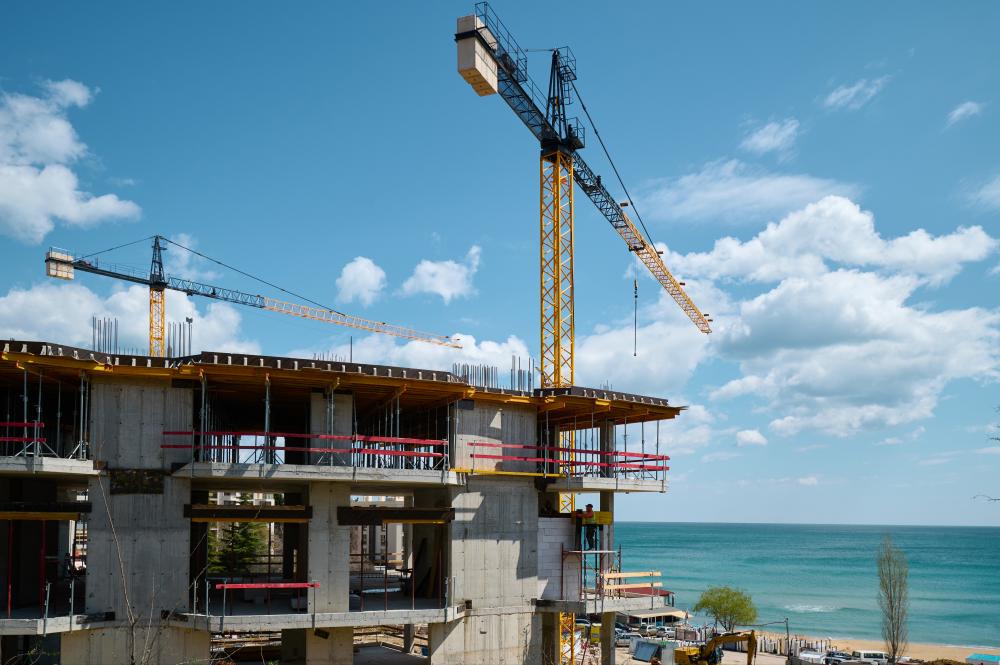
This is the most common fear about buying at construction stage, and behind it sits a very specific picture: a frozen excavation pit, a developer who has disappeared, people left with neither money nor an apartment. Those stories have happened in various markets, so the caution is earned rather than invented.
Cyprus is structured differently, largely because of scale. Projects here are usually small and conservatively financed. They are not thousand-unit towers but schemes that one company can realistically carry to completion, and they are costed accordingly. In our own practice we have not had a case of a developer going bankrupt mid-construction.
That said, your protection when buying off-plan does not rest on the developer's reputation. It rests on the law.
Cyprus has the Sale of Immovable Property (Specific Performance) Law, N. 81(I)/2011, and it works simply enough. You sign the contract of sale, and within six months of signing it is deposited with the Department of Lands and Surveys. From that moment your right to that particular unit is recorded by the state rather than promised by the seller.
What that gives you is concrete. The unit cannot be sold twice, because the Land Registry will not accept a second contract on the same property. It cannot be mortgaged behind your back without recourse, because deposit creates a charge that ranks by date of filing, so any later creditor of the developer stands behind you rather than in front of you. And if the developer fails to perform, you can go to court to demand transfer of your specific apartment rather than a sum of money you then have to collect from someone.
The protection starts when the contract is filed, not when you have paid the full price. One thing is required of you: making sure the contract really is submitted within the statutory six months, and that you get confirmation of it. Your lawyer handles this. It is not a bureaucratic formality, it is your actual insurance when buying a new build. If the deadline is missed the contract can still be filed later, but transfer fees are then increased by 10% when the property is registered.
A common objection, and it comes in two versions that are worth separating.
If the purchase is an investment, you want the money working sooner. Here it helps to count the outcome rather than the calendar. The entry price at an early stage is lower, and the gap between that price and the value of the completed property is your return over the build period. Payments to the developer are also staged against construction progress, so your capital is not frozen for three years in one go. For an investor that is a meaningful difference between paying once and waiting, and paying gradually while the asset is built.
If the apartment is being bought to live in, the argument reads differently. Few people want to rent for three years while a building goes up. That is fair, and the answer is not persuasion but the choice of stage. Between a foundation pit and a completed property with a title deed there is a whole range: projects at an advanced stage of construction, buildings delivering within a year, schemes with only the last few units left. A workable compromise is almost always available if the brief is framed as "I need to move in by this date" rather than "completed only".
This is the most emotional of the fears, because the buyer suspects they are being sold a pretty picture while something else gets built.
On the Cyprus market the render generally matches the result, and quite often the reality turns out better than the visualisation, since over two or three years of construction materials and specifications move on. Cases where something fundamentally different was built are so rare that each one becomes known across the whole market.
What genuinely does deserve checking is room sizes, and here the problem is real. Someone without architectural training can hardly picture from a floor plan how big a bedroom or a kitchen will be, and that is where the vague sense that it might all turn out small comes from. It is easily cured. Look at the square metres room by room, not only the total area. Ask what that total includes, because verandas and covered terraces are counted differently. Compare the figures against the home you live in now: "our current bedroom is 14 m², this one is 16" settles the nerves better than any render. The best test of all is to go and see a completed building by the same developer with similar layouts.
Specifications deserve a separate word. The specification must be in the contract with the developer, and in as much detail as possible. Not "quality ceramic tiles", but specific items, grades and dimensions. Everything promised in conversation should end up on paper, and that is a normal request which a reputable developer will not resist. Details like these are exactly where discrepancies tend to surface, and it is far better to find them before the deal than after.
Building permits in Cyprus do come through. Sometimes later than the original schedule, and it is more honest to say so upfront than to promise perfect timing, but the scenario where a permit is simply never granted is rare. Buyers who enter a project before permits are issued are compensated for it in the price, and that is a conscious trade rather than a surprise, provided someone has explained what the discount is for.
You may occasionally see a site on the island where work started and then stopped, and that sight worries people more than anything else. The explanation is usually technical. Permits carry validity periods and require works to begin within a set time, otherwise the document has to be obtained again, so a developer will formally start works to keep the permit alive and begin the active phase later. It is not a sign of trouble, but it is exactly the question to ask directly, and developer answers it without irritation.
As for the fear that a building will go up with serious breaches, it is theoretically possible and very uncommon. There is one preventive measure and it works: a transparent developer with a track record, with several completed projects in Cyprus that you can drive to and inspect with your own eyes.
This one has to be said plainly. At construction stage a separate title deed for your apartment does not yet exist. It is issued after the building is completed and certified. That is not a quirk of a particular developer, and it is not negotiable.
The wish behind it, though, is usually not about the title deed itself. It is about feeling protected, and that need is met in full. A contract deposited at the Land Registry already means the unit cannot go to anyone else, while the title deed later completes your ownership in legal terms. The title deed records the outcome. Registering the contract protects the process, and during construction the second is what you need.
The objection sounds logical, and until recently it was correct. From 1 September 2026 the rules for charging VAT on property in Cyprus changed, and many buyers are not yet aware of it, so it is worth going through in detail.
Previously a building's VAT status was determined by its age. Enough years since completion meant the property counted as old, and no VAT applied. The criterion is now tied to actual use. The law introduced the concept of first use, meaning systematic use of the property, whether owner occupation, letting or any other regular use, for a period of at least eighteen months.
The consequence is not obvious at first glance. If a property is sold before it has accumulated those eighteen months of genuine use, VAT applies on the sale, even if the building was completed long ago, even if a title deed exists, and even if formally this is a resale. Use is evidenced by documents: electricity and water bills, tenancy agreements, handover records, accounting and rental records. "Nobody ever lived in it" has become a verifiable fact, and the passage of time on its own no longer decides the question.
This most often affects exactly what buyers call a new resale. The building is delivered, the units are sold, some of them to investors who neither lived in them nor let them out, and a year later such a unit comes back to the market as a completed property with a title deed. The buyer assumes there is no VAT. Under the new rules there is, and the new buyer pays it.
From which follows something simple. The absence of VAT is no longer a property of the resale market, it is the result of a check on the specific unit. The gap between a new build and completed housing has narrowed accordingly, because "I will buy completed so I do not pay VAT" now only holds for properties with a documented history of use, which means genuinely older stock. There is an upside as well: under the new rules such properties can qualify for the reduced 5% VAT rate where the conditions on area, value and buyer status are met, whereas previously that was in some cases impossible in principle.
What you should be calculating is not the VAT line, but the whole cost of acquiring the property.
Buying a new build at the reduced rate, you pay 5% VAT, and the first registration of the title deed in your name carries no transfer fee, because VAT has already been paid. Buying a resale with a title deed and no VAT, you pay Land Registry transfer fees instead: 3% on the first €85,000, 5% from €85,001 to €170,000 and 8% above that, with a 50% reduction applied to transactions not subject to VAT. On typical values that works out at roughly 3% to 4% of the price, and it can be lower where the property is registered in joint names. A new resale that has not reached eighteen months of use will attract both the VAT and the registration costs.
Stamp duty no longer forms part of the calculation. It was abolished for documents signed from 1 January 2026, although Land Registry transfer fees and filing fees are unaffected by that change.
The option that looks the safestat first glance often turns out to be the most expensive overall. And since the VAT rule is very new and practice around it is still forming, the VAT status of a specific property is worth confirming with your lawyer before you pay a deposit, for a new build and for completed housing alike.
This gets discussed least of all, which is odd, because it is the whole point of buying off-plan.
The market renews itself every year and it shows across many parameters. Design solutions change, material quality rises, developers take energy efficiency more seriously year on year, which later shows up directly in your electricity bills, and new technologies appear, from smart-home systems to photovoltaics. A project designed today is almost always more up to date than one designed five years ago, and the difference is not cosmetic. It is easy to see for yourself by comparing the Cyprus new builds coming to market now with projects from the previous cycle.
To that, add two advantages the completed market cannot offer by definition. The first is choice. While the project is still selling you pick the best unit, the floor, the view and the orientation, whereas in a finished building you choose from what is left. The second is the ability to adapt the apartment to yourself. In most projects you can select finishes and often adjust the layout. Where it is a matter of choosing a colour or a finish option within the same grade there is usually no surcharge, while more complex changes are handled separately as an extra cost, which is fair enough. In a straightforward and good-natured transaction developers often accommodate part of the changes free of charge.
In an older building, reconfiguration is frequently impossible, and even after a good renovation the feeling remains that this is an old building with new insides.
Concerns about new builds in Cyprus almost always turn out to be fear of the unknown rather than of a real risk. Most of them are answered by three things: the Specific Performance Law, the developer's track record, and a contract that spells out the details.
In return, buying at an early stage gives you what the completed market barely offers today. The pick of the best unit, current construction quality, the right to change things to suit yourself, and a noticeably better entry price. Understanding a specific project is not a matter of faith in the developer. It is a handful of checks, and every one of them can be done before you sign anything.
Author: Dina May, journalist

 Russian
 German
 Hebrew
 Greek
Greek French
 Italian
 Spanish
 Arabic
 Serbian






Get Free Consultation